Why Red Activewear Fades Faster Than Every Other Color
Quick Answer: Red fades faster because red dyes are chemically less stable under UV light and hot water than the dyes used for black, navy, and grey. Red also shows fading more visibly — a 10 percent loss of dye shifts red toward pink or coral, a shift the eye reads immediately, while the same loss in black just reads as slightly less black. The fix is mostly washing behavior: cold water, inside out, short cycles, and never drying in direct sun.
The good news is that red responds well to correct care. Most red pieces that fade in months were washed in a way that would have faded any color, just less visibly.
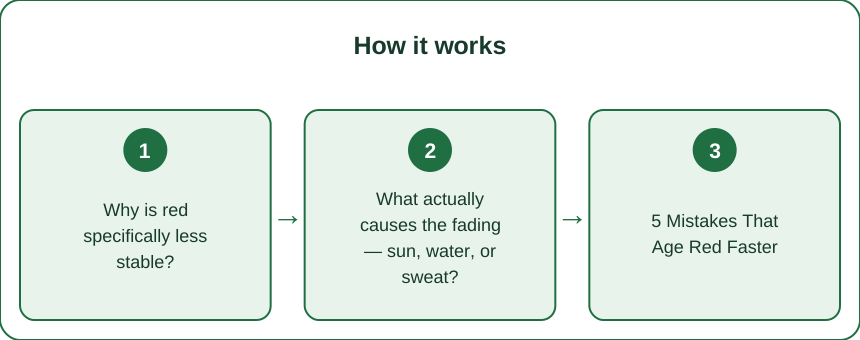
Why is red specifically less stable?
Two reasons stack on top of each other: the chemistry and the perception.
The chemistry. The dye molecules that produce vivid reds tend to have less light-fastness than those used for blacks and deep blues. UV light breaks down dye molecules over time, and red pigments are among the more vulnerable. This is not unique to clothing — it is the same reason red paint and red printed signage fade first outdoors.
Red dyes also have a weaker affinity for synthetic fibers than some other colors. Polyester and nylon, which make up most activewear, are dyed under heat and pressure, and reds often sit closer to the surface of the fiber. Surface-bound dye is the first to go in the wash.
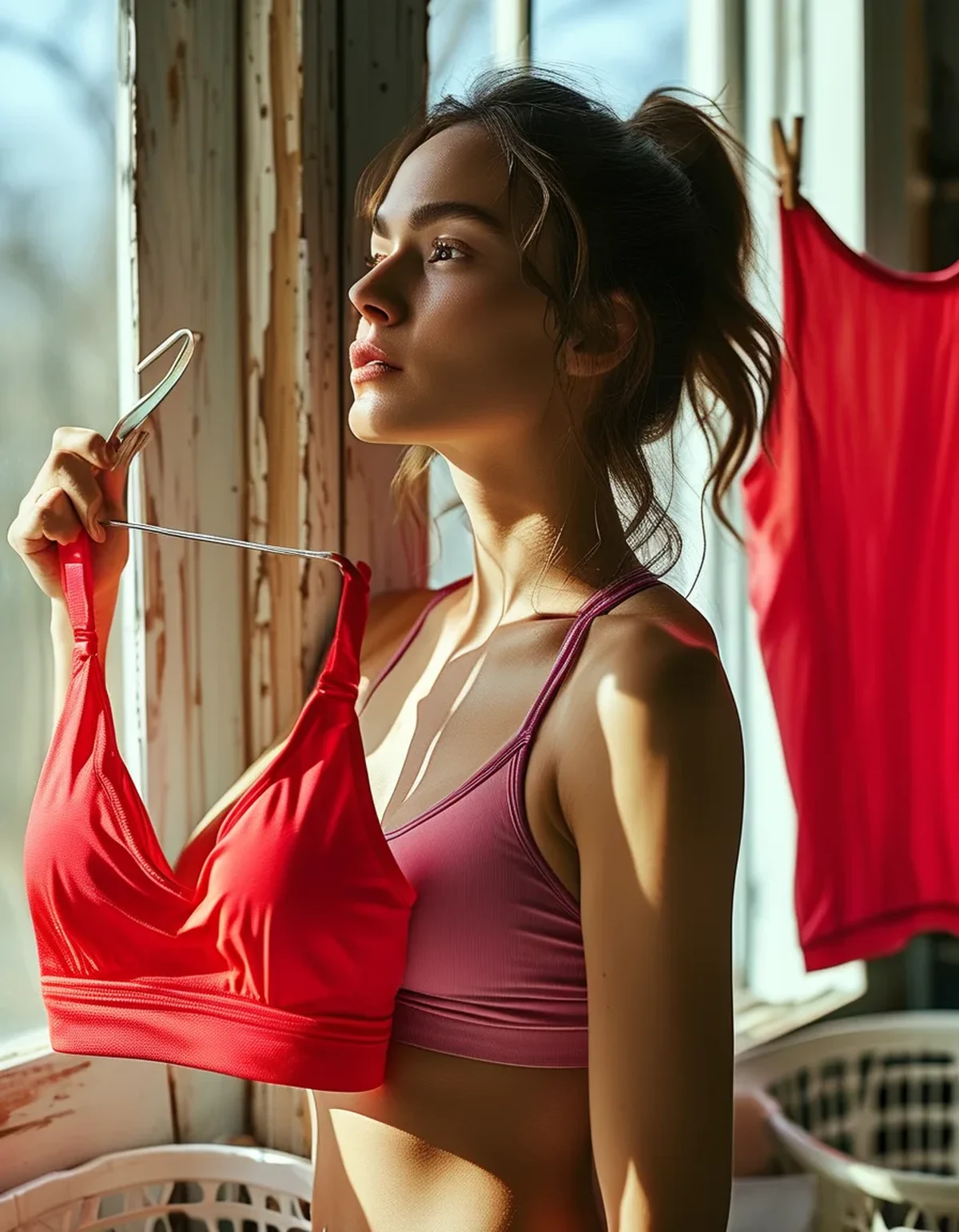
The perception. This part is underrated. A red garment that has lost a modest amount of dye reads as a different color entirely — it goes toward salmon, coral, or dusty rose. Your eye is very sensitive to that shift.
The same proportional loss in a black garment produces a slightly warm charcoal, which most people never consciously register. Navy goes slightly softer. Grey barely changes at all.
So red is losing dye somewhat faster and announcing it far more loudly. The combination is why the red set always seems to be the one that ages first, even when it has had exactly the same treatment as everything else in the drawer.
What actually causes the fading — sun, water, or sweat?
All three, in a specific order of severity.
Heat is the biggest culprit, and it is mostly the dryer. High-heat tumble drying does more damage to color than any number of washes. The combination of heat and mechanical agitation lifts surface dye and abrades the fiber face, and for red the effect shows up fast. If you change one thing, change this.
Direct sun is second, and it is worse than people expect. Drying a red garment on a line in full sun is effectively a UV exposure session, and doing it repeatedly through summer produces visible fading in a season. Drying in shade costs an extra hour and preserves the color.
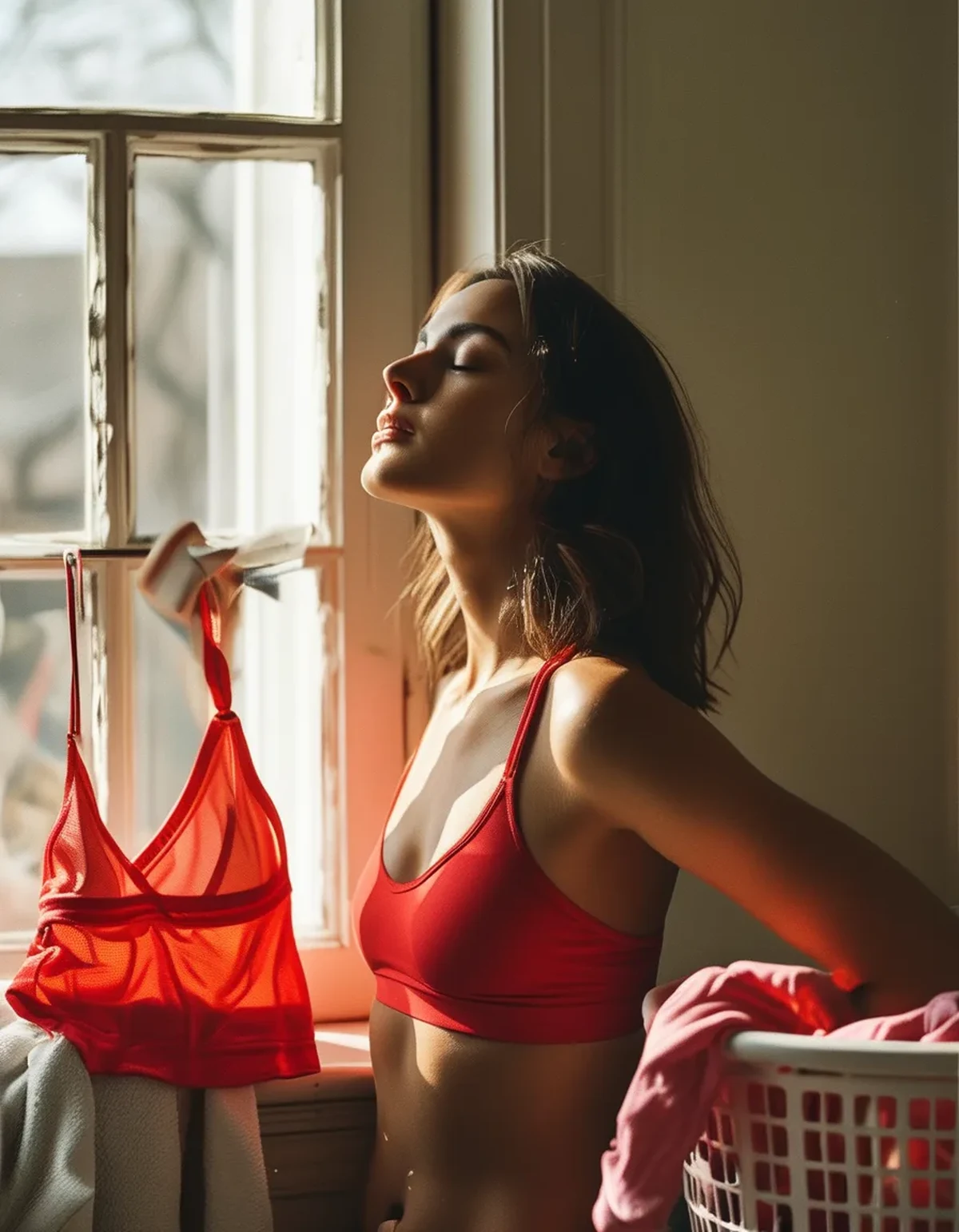
Sweat is third, and it works through pH rather than heat. Sweat is mildly acidic and, left in the fabric, it slowly attacks the dye and the elastane together. A red garment left damp in a gym bag overnight is getting a concentrated dose of exactly the chemistry that damages it. This is the mistake that separates a red set that lasts two years from one that lasts four months.
Detergent is fourth. Anything with optical brighteners or bleach alternatives is designed to alter how color reflects light, and on red that reads as dulling. Ordinary detergent is fine; whitening or brightening formulas are not.
Water temperature matters, but less than the list above suggests. Cold washing helps, and it helps considerably less than skipping the dryer does.
5 Mistakes That Age Red Faster
Leaving it damp in a bag. Sweat sitting in the fabric for hours is the highest-damage thing you can do to a red piece short of bleaching it. Rinse it in the sink if you cannot wash it, and hang it to dry regardless.
Washing it with towels. Towels are abrasive and shed lint, and the mechanical action against a smooth synthetic face lifts surface dye. Red belongs with other smooth synthetics, not with cotton terry.
Using fabric softener. Softener coats synthetic fibers, which dulls the surface and traps odor. On red it produces a specific chalky flatness that people often mistake for fading. It is actually a film, and it is partly reversible with a vinegar rinse.
Drying it in the sun to kill smell. Sun does reduce odor, and it fades red substantially. Use shade plus a proper wash instead — the odor problem is a bacteria problem, and sunlight is a poor way to solve it.
Washing it too rarely. People try to preserve color by washing less, and for sweat-facing garments that backfires. Accumulated sweat degrades both dye and elastane. Washing after every wear, correctly, beats washing occasionally and harshly.
The fifth one catches people out constantly, because it feels like the careful choice. For red activewear specifically, frequent gentle washing is the preserving option.
How should you wash a red set to keep it bright?
A short, cold, gentle routine that takes no more effort than what you do now.
Turn it inside out. The outer face is what you see, and inside out means the abrasion happens on the inner surface. This single step meaningfully slows visible fading.
Cold water, gentle or delicate cycle, and keep it short. Longer cycles mean more agitation, not more cleaning, for lightly soiled synthetics. Thirty minutes cold is plenty.
Wash with like fabrics and like colors, and do not overload. A crowded drum increases abrasion. Half-full is better for color than full.
Ordinary liquid detergent, no softener, no brighteners. A sport-specific detergent is worth it if odor is an issue, since it targets the oils that hold smell, but it is not required for color.
Hang to dry in shade, indoors or out. This is the highest-value step on the list. If you must use a machine, use the lowest heat or an air-dry setting and pull it out slightly damp.
For a new red piece, wash it alone the first time. Excess surface dye comes off in the first one or two washes and will transfer to anything light in the drum. This is not a defect — it is normal for reds, and it stops after a couple of cycles.
In late summer, one extra note: the after-workout window is short in heat. A red set worn outdoors in August is holding more sweat than the same set in October, and it is being carried home warm. Getting it out of the bag within the hour is worth more for that set than any laundry product you can buy.
FAQ: Red Activewear Questions, Answered
Can I restore a faded red piece?
Not really. Dye loss is permanent, though a vinegar rinse can remove softener buildup that mimics fading. If a piece looks flat rather than pink, buildup is worth ruling out first — it is the only reversible case.
Do more expensive red pieces fade less?
Sometimes, because better dyeing processes bind dye deeper into the fiber. But care behavior explains more of the variation than price does, and an expensive red dried on high heat will fade faster than a cheap one line-dried in shade.
Should I avoid red for outdoor training?
No — just accept that an outdoor red piece has a shorter bright life than an indoor one, and treat it accordingly. Save the newest red set for indoor sessions and photos, and let an older one take the sun.
TL;DR:
- Red dyes are less light-fast and sit closer to the fiber surface, and red shows dye loss far more visibly than dark colors.
- Dryer heat and direct sun cause the most fading; sweat left in the fabric is the third and most avoidable cause.
- Wash inside out, cold, short, no softener, and dry in shade.
- Wash red activewear after every wear rather than saving it — accumulated sweat damages more than gentle washing does.
The next time you get home from a hot session, get the red set out of the bag first. That one habit does more than every laundry product combined.
Keep Reading
This article is for general informational and styling purposes only. Fit, sizing, and product availability may vary.