How Much Red an Outfit Can Take Before It Stops Working
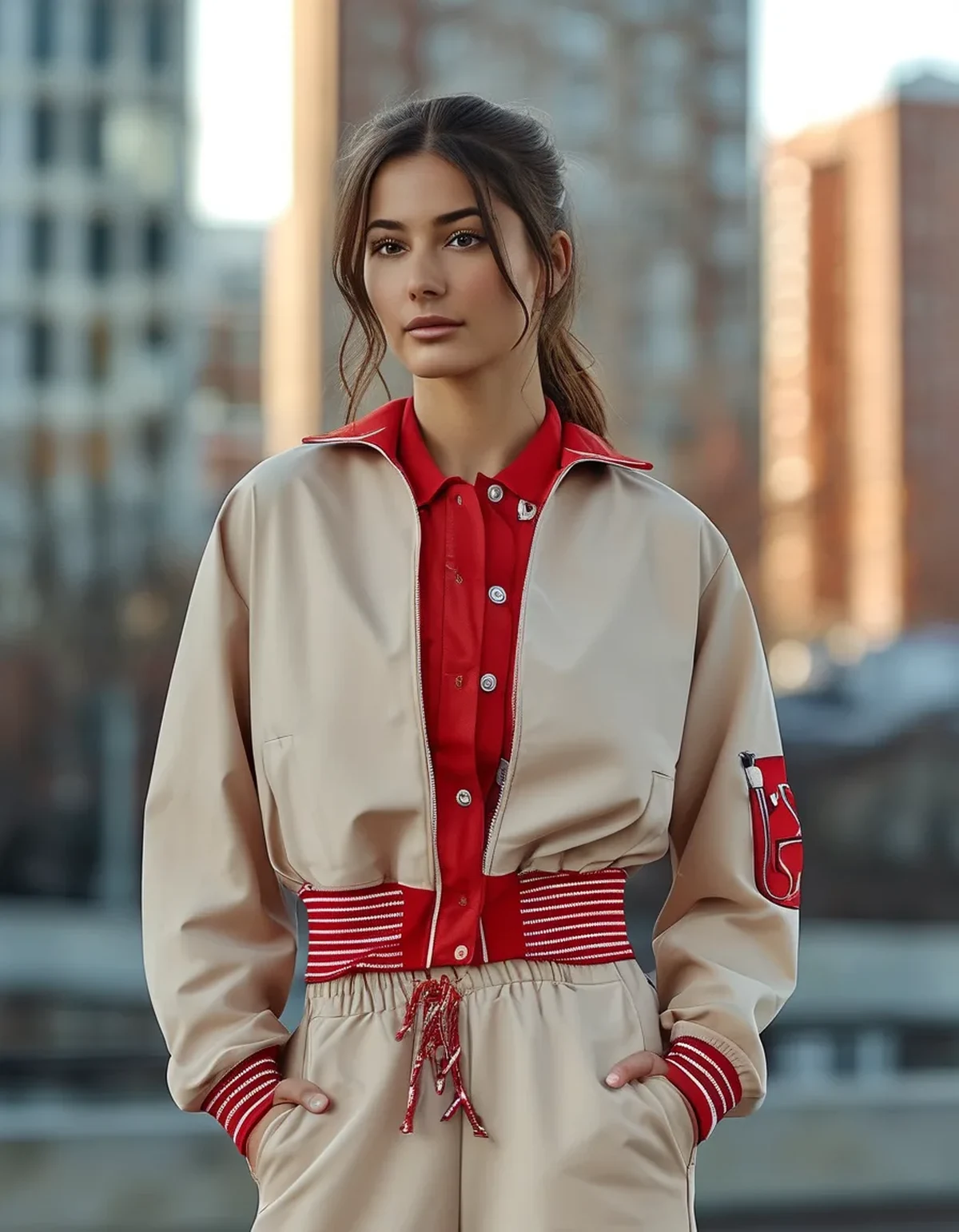
Quick Answer: A red accent works when it’s the single strongest color in the outfit and occupies roughly 10 to 20 percent of the visible area — enough to draw the eye, small enough that nothing competes with it. Two red pieces of similar size split the focus, and the outfit loses the anchor that made the accent work in the first place.
The rule isn’t about how much red you like. It’s about how many focal points an outfit can support, which turns out to be one.
Why does a single accent read better than two?
Visual hierarchy depends on something being clearly dominant. When one element is unmistakably the brightest or most saturated, the eye lands there first and then travels outward — that path is what makes an outfit feel composed.
Two similarly-sized red pieces create two competing focal points with no clear winner, so the eye bounces between them without settling. The result reads as busy rather than bold, even though nothing about either piece has changed. This is why a red sports bra under a neutral top works beautifully and a red bra with red shoes often doesn’t — the second piece didn’t add emphasis, it divided it.
What’s the right proportion for an accent?
Roughly 10 to 20 percent of the visible outfit area is the range where an accent reads as intentional emphasis. Below about 5 percent it registers as a detail rather than a statement — fine, but it isn’t doing the work of an accent.
Above about 30 percent, red stops functioning as an accent and becomes the outfit’s base color, which is a different and equally valid choice — it just needs different support. A red legging with a neutral top is a red outfit with a neutral accent, not the reverse. The failure zone is the middle, roughly 20 to 30 percent, where red is too large to be an accent and too small to anchor the outfit.
Do two reds ever work together?
Yes, under two conditions. When the two pieces are dramatically different in size — a red legging with a small red detail on a shoe, for instance — the hierarchy is preserved because one is clearly dominant.
And when the two reds are deliberately different in depth, like a deep brick with a bright scarlet, the eye reads them as a tonal pairing rather than a competition. What consistently fails is two similar reds at similar sizes, which is the near-match problem again: close enough to look like they should match, different enough that the mismatch is visible. If two reds are going in one outfit, make them obviously different or obviously identical.

How does the neutral base change what red does?
Substantially. Against black, red reads as bold and high-contrast — it’s the most dramatic pairing and the most forgiving of proportion, since black recedes so completely.
Against gray, red reads softer and more sophisticated, because gray is closer in value to most reds and the contrast is gentler. Against camel or tan, red reads warmer and more autumnal, which is a natural fit for the late-summer-into-fall window. Against white, red reads sharpest and most graphic — striking, but the least forgiving, since white amplifies every proportion decision. Choosing the base first and the red second is generally the easier order.
5 Mistakes People Make With Red Accents
1. Adding a second red because the first one worked. The first one worked because it was alone.
2. Using two near-matching reds. Obvious contrast or exact match — never close.
3. Placing the accent at the widest point of the body. A bright color draws the eye, so put it where you want attention.
4. Pairing red with another saturated color as an equal. Red will win, and the other color will just look muddled.
5. Ignoring undertone. A blue-based red and an orange-based red suit different complexions, same as any other color family.
FAQ: Red Accent Questions, Answered
Does the accent need to be a garment, or can it be a shoe or bag?
Either works — the proportion rule is about visible area, not about which item. A red shoe often lands right in the 10-20 percent range naturally.
Which red suits most people?
A true red with a slight blue lean tends to be the most broadly flattering, since it doesn’t compete with warm or cool undertones as directly as orange-red or burgundy do.
Can red work as a full activewear set?
Yes, but then it’s the base rather than the accent — pair it with genuine neutrals and skip additional bright colors entirely.
TL;DR:
- An outfit supports one focal point; a second red divides attention rather than doubling it
- Aim for 10-20 percent of visible area for a true accent; over 30 percent makes red the base color
- Two reds work only when dramatically different in size or clearly different in depth
- Choose the neutral base first — black amplifies, gray softens, camel warms, white sharpens
One strong red does more than two competing ones. Pick the piece, let it lead, and keep everything else quiet.
See It in Motion
Seen here: High Waist 8” Yoga Shorts — shop similar styles on bubblelime.com
Keep Reading
This article is for general informational and styling purposes only. Fit, sizing, and product availability may vary.